
Your Journey in America
Getting a US Driver's License: The Universal Playbook
Written and verified by the SOSGI Editorial Team
10 min read · Updated September 21, 2026
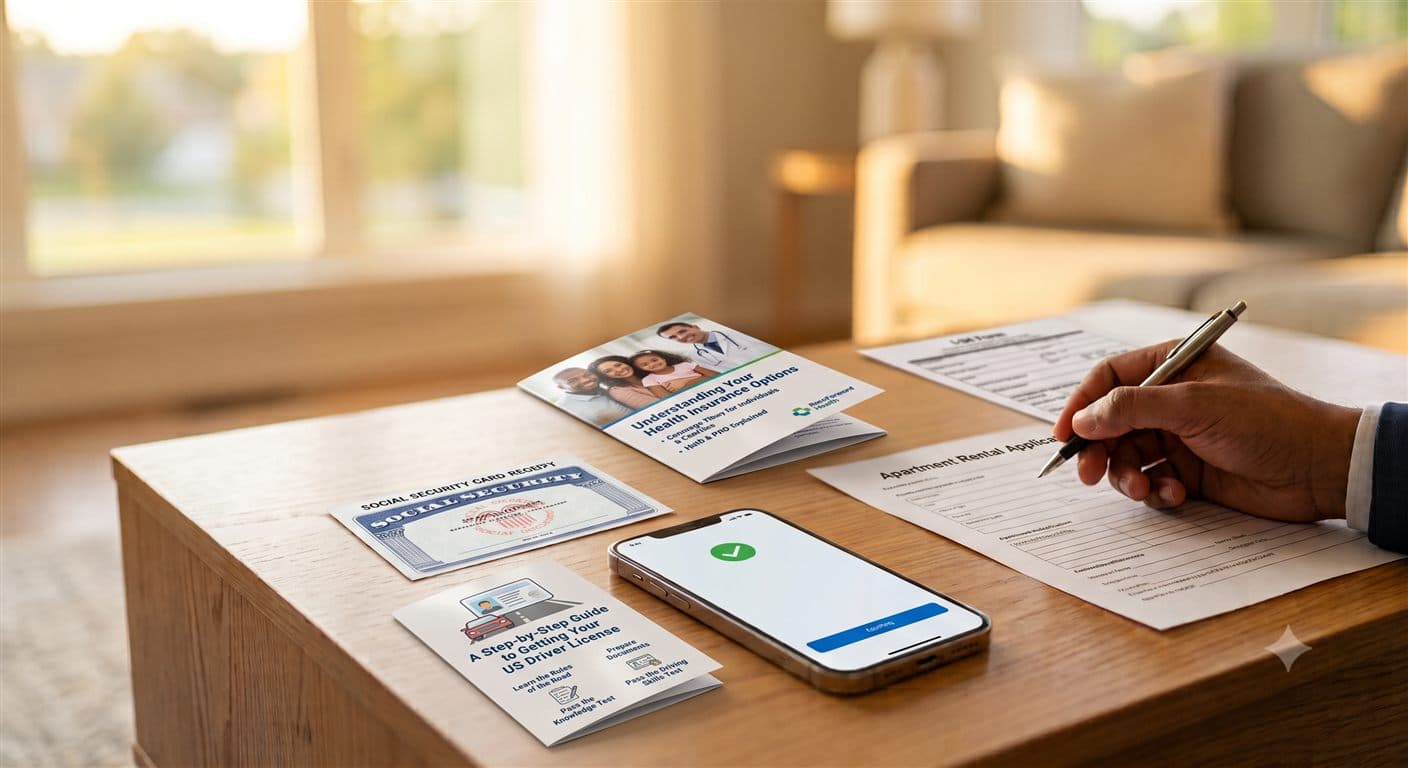
Licences are issued by states, not the federal government, so the details depend on where you live. The sequence, though, is remarkably consistent everywhere — which turns a bureaucratic maze into a short series of DMV visits.
Jump to the checklist ↓Driver's licenses in the United States are issued by states, not the federal government, so the exact rules depend on where you live — but the sequence is remarkably consistent everywhere, and knowing it turns a bureaucratic maze into a short series of DMV visits. This guide covers the documents most states ask for (some combination of identity, residency and lawful-presence proofs — the exact list is your state's), the test path, driving legally while you wait, REAL ID (since 7 May 2025 a state driver's licence or ID used at a TSA checkpoint must be REAL ID-compliant — but a US or foreign passport, a permanent resident card, a DHS trusted-traveler card and other listed documents are accepted instead, so REAL ID is one option, not the only one), and the insurance that must accompany the license. Always confirm the specifics on your own state's official DMV site, which USA.gov links for every state.

The checklist
12 steps
- 1Check your state's DMV on whether an International Driving Permit helps before you are licensed locally
- 2Check your state's foreign-license grace period on the official DMV site
- 3Gather passport, I-94, status document, and residency proofs
- 4Bring your SSN or an SSA ineligibility letter
- 5Bring the fuller document set so your first license is REAL ID
- 6Study the state manual, then pass the knowledge and vision tests
- 7Practice on the learner's permit, then pass the road test
- 8Get liability insurance before driving — never drive uninsured
- 9Compare insurer quotes and re-shop rates as US history builds
- 10Learn school-bus stops, four-way stops, and right-turn-on-red rules
- 11Keep your DMV address current and calendar the license expiration
- 12Get a state ID card for household members who won't drive
This checklist is your map, not the route. The devil is in the details — read the full guide below before acting on any item.
Why this is about more than driving
The driver's license — or the state ID card issued by the same office for non-drivers — is America's everyday identity document. It is what you show for age checks, building access, notarizations, medical appointments and countless small verifications. Carrying your passport everywhere is a genuine loss risk; getting the state credential early ends that.
Since May 7, 2025, federal REAL ID enforcement has been in effect: to board domestic flights, adults need a REAL ID-compliant license or ID (marked with a star), or an acceptable alternative such as a passport. Non-citizens with proof of lawful presence are eligible for REAL ID credentials, generally issued as limited-term cards tied to your period of stay. Practical upshot: when you apply, bring the fuller REAL ID document set so your first license is the compliant one — otherwise you will keep carrying your passport to airports.
The five things nearly every state requires
Proof of identity and lawful presence: passport with visa, your I-94 record, and typically your status document (I-20 for students, DS-2019 for exchange visitors, I-797 for workers). States verify immigration status electronically, so allow time after arrival for records to propagate — applying in your very first days can produce avoidable verification failures.
Proof of state residency: usually two documents — lease, utility bill, bank statement, or similar. This is why the proof-of-address folder from your first weeks matters.
An SSN, or proof you are not eligible for one: if you have a Social Security number, you provide it; if you are not work-authorized (for example an H-4 spouse without an EAD), states have a process using an SSN-ineligibility letter from the Social Security Administration.
A knowledge test on the state's driving manual, plus a vision screening. The manual is a free PDF on every state DMV site, and official practice tests are often available.
A behind-the-wheel road test, taken in a car you bring — which must be registered and insured. Many newcomers take the test in a friend's insured car or a driving-school car.
The path, start to finish
The typical sequence: study the state manual → pass the knowledge test and vision screening → receive a learner's permit → practice legally (states set rules about supervision) → pass the road test → receive the license. Adults with prior driving experience can often move through this in weeks; the constraint is usually appointment availability, so book DMV slots early.
A note on prior licenses: some states waive tests for holders of licenses from specific countries with reciprocity agreements. India is generally not on those lists, so plan on taking both the knowledge and road tests. Your years of Indian driving experience still help — you only need to learn the local rules (right-side driving, four-way stops, school-bus laws, right-turn-on-red where permitted) rather than how to drive.
If you fail a test, it is routine to retake it after a short waiting period, sometimes with a small fee. Nothing is recorded against you; treat the first attempt as reconnaissance if needed.
License validity for noncitizens is usually tied to your authorized period of stay: many states issue limited-term licenses that expire with your I-94 or status document and renew when you extend status. Keep this in mind when your H-1B or F-1 dates change — a status extension usually means a license-renewal trip too.
Your license and your paper trail
The license application quietly depends on the paperwork habits from your first weeks: your I-94 (immigration verification), your SSN or ineligibility letter, and two proofs of address. Newcomers who kept a documents folder walk out with a license; those who didn't make three trips. Before booking, run your DMV's online document checklist and lay the originals out.
Name consistency matters here as much as everywhere else in American bureaucracy. The name on your license application should match your passport and immigration documents exactly — mismatches between 'first name/last name' splits are a common Indian-applicant issue (single names, or father's name used differently). If your documents differ, ask the DMV how they handle it before the appointment rather than at the window.
Driving while you wait: the foreign-license window
Most states allow new residents to drive for a limited period on a valid foreign license — sometimes paired with an International Driving Permit (IDP), which is essentially an official multi-language translation of your license. An International Driving Permit is not a US licensing requirement; whether it helps you drive on your Indian licence before you are licensed locally is a state rule — check your state's DMV. If your state wants one, it is issued in India by the authority that issued your license, so arrange it before you travel.
Two cautions. First, the grace period's length varies by state and generally runs from when you establish residency — not from your last entry — and some states expect residents to get a local license quite quickly. Second, an IDP is not a license by itself; it is only valid alongside your original license. Verify your state's exact rule on its official DMV page rather than relying on what worked for a friend in another state.
Insurance: the non-optional companion
Nearly every state requires liability insurance (or an equivalent proof of financial responsibility) before you drive, and penalties for uninsured driving include fines, license suspension, and — far worse — unlimited personal exposure if you injure someone. Never drive uninsured, even briefly.
Insurers price heavily on US driving history, which you do not have yet — so newcomer premiums start high and fall meaningfully after your first claim-free years. Three ways to keep the start affordable: compare several insurers (prices for the same driver vary widely), ask about defensive-driving-course discounts, and re-shop your rate every year as your US history builds. Indian driving history generally does not transfer, though a few insurers ask about prior licensing.
Before buying any car, get insurance quotes for that specific model first — insurance can rival the car payment for a new driver. And use the free federal safeguards on the used market: the NHTSA VIN lookup for open recalls, and your state's title-check guidance to avoid washed or salvage titles.
The road rules that surprise Indian drivers
American driving has a handful of rules with no Indian equivalent, and knowledge tests love them. Stopping for school buses: when a school bus stops with red lights flashing and its stop arm out, traffic in both directions must generally stop (rules for divided highways vary by state) — passing a stopped school bus is one of the most heavily penalized violations in the country.
Four-way stops work on arrival order: first to stop, first to go, yielding to the right on ties. Right turn on red is permitted in most places after a complete stop unless a sign prohibits it — but never assume in a new city. Pedestrians in crosswalks have the right of way, and drivers genuinely stop for them. Speed limits are enforced, including by camera in some jurisdictions, and school zones carry sharply lower limits at posted times.
Two behavioral notes: honking is rare and read as aggression, not communication; and if police stop you, stay in the car with your hands visible, and follow instructions — the officer expects you to remain seated, which is the opposite of the Indian instinct to step out.
Test-day and DMV practicalities
Book appointments online wherever your DMV allows it — walk-in waits can consume a day. Bring originals of every document on the DMV's checklist (most DMV sites have an interactive document checklist tool; run it and print the result). Missing one document is the most common reason for a wasted trip.
For the road test, arrive with the vehicle's registration and insurance card, working lights and signals, and a full understanding of the test route basics: parking maneuvers, lane changes, intersections. Local driving schools know each DMV office's test patterns and a single lesson before the test is often worthwhile even for experienced drivers.
Once you have the license, calendar its expiration and keep your address current with the DMV — most states require address updates within a set number of days of moving, and renewal by mail or online is often possible only if your record is current.
If you don't drive: the state ID card
Every state's licensing agency also issues a photo ID card for non-drivers, using essentially the same identity and residency documents without the tests. For a spouse or parent who will not drive, this card solves the everyday-identity problem — including the REAL ID version for domestic flights — and is usually inexpensive.
The application process mirrors the license: same office, same document checklist, same photo. If a household member is settling in for a long stay, getting them a state ID in the first month spares them carrying a passport for every small verification, and gives them a US credential for banking and medical settings.
The mistakes that cost newcomers here
Waiting too long. The foreign-license grace period ends whether or not you noticed, and driving unlicensed or uninsured converts a paperwork lapse into fines, suspension risk and insurance problems that follow you. Start the process in month one, even if you don't plan to buy a car soon — the license is your ID either way.
Assuming another state's rules. Everything here — grace periods, document lists, test waivers, limited-term validity — varies by state, and moving states means getting that state's license within its new-resident window. What your cousin did in Texas may simply be wrong in New Jersey.
Skipping the REAL ID document set to save one trip, then discovering at the airport that the standard license cannot board a domestic flight. Bring the fuller document set the first time.
And paying 'agents' for DMV appointments or 'guaranteed passes' — everything in this process is direct, official and low-cost through your state DMV site. Anyone selling shortcuts to a government process you can do yourself is a red flag, here as everywhere.
Official sources
Keep reading
- Moving to the USA: The Complete 24-Point Relocation ChecklistYour Journey in America
- Getting Your Social Security Number: The Complete ProcessYour Journey in America
- Opening Your First US Bank Account: Documents, Choices, TrapsYour Journey in America
- The US School System, Explained for Indian ParentsHousing & Daily Life
Disclaimer
This article is general information, not professional advice, and does not create any professional relationship. Rules, fees, dates and eligibility change and can vary by state, agency and individual circumstances. Always cross-verify the details against the official sources listed above before you act, and consult a qualified professional about your specific situation.