
Your Journey in America
Moving to the USA: The Complete 24-Point Relocation Checklist
Written and verified by the SOSGI Editorial Team
11 min read · Updated September 21, 2026
At a glance
24 checkpoints · 3 phases — Before you fly → First week → First month
Costliest mistakes: the $10,000 cash rule · rental wire scams · the 10-day address rule
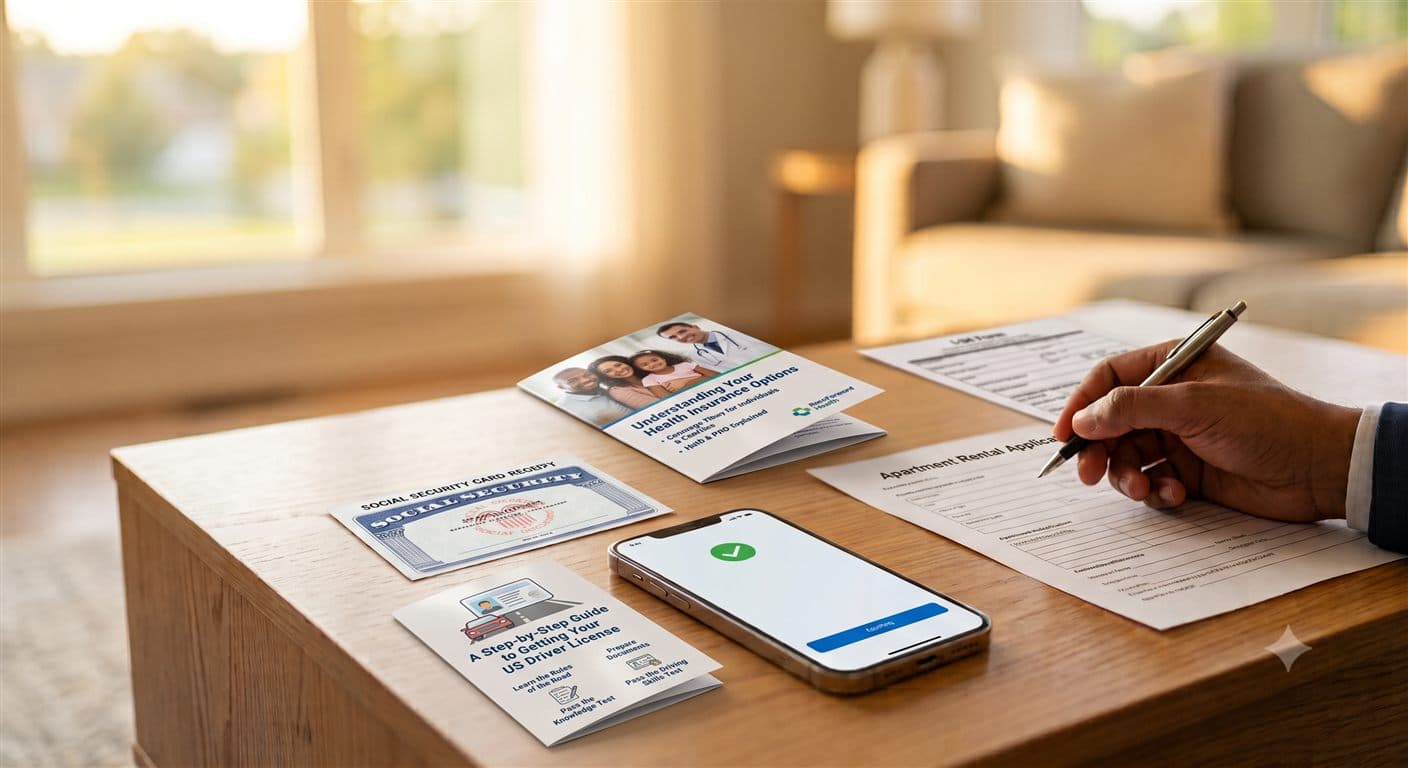
Twenty-four checkpoints across three phases — before you fly, your first week, your first month. Done in this order, everything that follows gets easier.
Jump to the checklist ↓The first few months in America involve a predictable sequence of paperwork and setup, and doing it in the right order makes everything that follows easier. This checklist covers 24 checkpoints across three phases — before you fly, your first week, and your first month — from the documents you assemble in India to a functioning American life. Requirements vary by state and visa category, so treat each item as a prompt to verify with the relevant official source (linked at the end), not as a substitute for it.

The checklist
24 steps
- 1Assemble documents folder: passport, visa, status documents, degree certificates, transcripts
- 2Build the medical file: vaccination records, prescriptions in original packaging, doctor's letters
- 3Plan week-one money and notify your Indian bank before travelling
- 4Arrange insurance covering the gap until employer or university coverage begins
- 5Have a working number for landing day; keep the Indian SIM for OTPs
- 6Book verified arrival housing; never wire deposits for unseen apartments
- 7Declare currency over the reporting threshold to CBP on FinCEN Form 105
- 8Save document scans to secure cloud storage; share access with trusted family
- 9Retrieve your I-94 online and verify class and admit-until date
- 10Apply for your SSN as soon as your status allows
- 11Open a bank account with passport, visa and I-94
- 12Activate a US number and share it with family, employer, university
- 13Most noncitizens must file Form AR-11 within 10 days of moving — one per person; A and G visa holders and Visa Waiver visitors are exempt
- 14Save emergency numbers: 911, your consulate, your insurer's nurse line
- 15Start a proof-of-address folder with your lease and first bills
- 16Note your deductible, network, and nearest in-network urgent care
- 17Start credit with a secured card paid in full automatically
- 18Begin the driver's license process from your state's DMV checklist
- 19Set up utilities and internet in your own name
- 20Get renter's insurance; photograph the unit at move-in
- 21Establish an in-network primary care doctor before you need one
- 22Enrol children in school: address proof, immunization mapping, transcripts
- 23Note your tax residency and any FBAR or FATCA duties
- 24Find your community: one association, one activity, real people
This checklist is your map, not the route. The devil is in the details — read the full guide below before acting on any item.
How to use this checklist
Work through the phases in order. Much of the sequence is dependency-driven: your I-94 and status documents enable your Social Security number where eligible, which makes banking and credit easier, which in turn supports housing, a driver's license and more. Skipping ahead usually means backtracking.
Two rules apply throughout. First, keep originals safe and carry copies; scan everything to secure cloud storage. Second, when an item involves a government requirement — customs declarations, address reporting, tax status — confirm the current rule on the official page rather than relying on what a friend did a few years ago.
A simple tracker helps. Keep a single note or spreadsheet listing each checkpoint, the document or account it produces, and its status, so nothing falls through the cracks during a busy few weeks. Many of these steps have a natural order but can be prepared in parallel — for example, you can gather your driver's license documents while you wait for your SSN card to arrive. The goal is steady progress through the sequence, not doing everything at once on day one.
Before you fly (items 1–8)
1. Documents folder. Assemble your passport (with sufficient validity — for US entry an Indian passport generally needs to be valid for the intended period of stay, not six months beyond it; check the airline's rules and the rules of any other country on the itinerary), visa, and status documents (I-20, DS-2019, I-797, or offer letter as applicable), plus original degree certificates and transcripts, a marriage certificate if relocating with a spouse, and birth certificates for children.
2. Medical file. Carry vaccination records (translated to English where needed), prescriptions in their original packaging with a doctor's letter, and recent test reports and eyeglass prescriptions. This helps with school enrolment, new doctors, and airport questions.
3. Money plan. Have some US dollars for the first week, notify your Indian bank that you are travelling, and be clear on how you will access funds until a US account opens. If you are carrying a large sum, see the customs rule in item 7.
4. Insurance bridge. Arrange coverage for the gap until employer or university insurance begins. US medical costs make even a short uninsured gap a real financial risk.
5. Phone plan. Have a working number for landing day (an eSIM or roaming), and keep your Indian SIM active for one-time passwords tied to Indian bank accounts.
6. Housing for arrival. Book somewhere for your first weeks. Never wire a deposit for an apartment you (or someone you trust) has not verified exists — advance-deposit rental scams specifically target people relocating from abroad.
7. Customs preparation. If you carry currency or monetary instruments exceeding $10,000 (this threshold applies to the total for a family or group travelling together, in either direction), US rules require you to report it to CBP, generally on FinCEN Form 105. Failing to report can lead to seizure and penalties. Also review current food and agricultural restrictions and declare items honestly. Confirm details on the CBP page on money and monetary instruments ↗ — the reporting rules and the amount that triggers them can change, so check them there before you fly.
8. Backups. Save scans of every document to secure cloud storage and share access with a trusted family member.
At the border: your first hour in the US
On arrival, you pass through inspection by a CBP officer, who checks your passport, visa and purpose of travel and decides on your admission. Keep your passport, visa, and status documents (I-20, DS-2019, I-797, or offer letter) easily accessible, along with proof of your address and funds if asked. Answer questions clearly and truthfully; this inspection is what creates your electronic I-94 admission record.
After you clear customs, your admission is recorded electronically — there is usually no paper I-94 stamped into your passport, which is why retrieving your I-94 online (item 9) matters. Note the class of admission and the authorized period; if anything looks wrong, it is far easier to address early. If you are travelling with family, each person has their own admission and their own I-94 to verify.
Week 1 — identity foundations (items 9–16)
9. Retrieve your I-94. Download your I-94 admission record from the official CBP website and confirm the class of admission and the 'admit until' date are correct — this record, not the visa stamp, controls your authorized stay, and errors do occur. (Students: F and J entries currently show 'D/S' rather than a date. A 2026 DHS rule that would replace that with a fixed end date was postponed by a federal court on September 14, 2026 and is not in force; the position is unsettled, so confirm the current status at studyinthestates.dhs.gov before relying on either — and know what your own record shows.)
10. Apply for your SSN. If you are authorized to work, apply for a Social Security number as soon as your status allows (see our SSN guide). Most later steps are easier once you have it.
11. Open a bank account. US customer-identification rules let banks verify identity with a passport, so major banks can often open an account with your passport, visa and I-94 before the SSN arrives (see our banking guide).
12. Activate a US phone number. Get a US number working and share it with family, your employer or university, and for account verifications.
13. Report your address as required. Employers and universities need your address; separately, US immigration rules require most noncitizens to report a change of address to USCIS within 10 days of moving (with limited exceptions), generally via Form AR-11 or an online account. Confirm the current rule on the USCIS change-of-address page.
14. Save emergency numbers. Program 911 (US emergency services), your consulate's line, and your insurer's nurse or help line.
15. Start a proof-of-address folder. Keep your lease and first utility set-ups — banks, the DMV and others will ask for proof of address.
16. Learn your health-plan basics. Before you need care, note your deductible, your network, and the nearest in-network urgent care and hospital (see our health-insurance guide).
Month 1 — build the rails (items 17–24)
17. Start building credit. Once eligible (generally after your SSN), open a suitable starter account such as a secured card, use it for a small recurring charge, and pay it in full automatically (see our credit guide). US credit history starts from zero and takes time.
18. Begin the driver's license process. Licenses are issued by states, so study your state's manual, book the knowledge test, and gather your DMV's document checklist (see our driver's license guide). Rules and grace periods vary by state.
19. Set up utilities and internet in your name. Each bill also serves as proof of address (see our day-one setup guide).
20. Get renter's insurance if leasing. It is usually inexpensive and often required by landlords; photograph the unit at move-in to document its condition.
21. Establish primary care. Choose an in-network primary care doctor and book an initial visit, so you have an established relationship before you need one.
22. Enrol children in school. Check the district's proof-of-address rules, map your children's immunizations to the state's school requirements, and bring prior transcripts (see our US school system guide).
23. Understand your tax position. Note your likely residency status for tax purposes for the year, and whether you have FBAR or FATCA reporting duties if you kept Indian accounts (see our NRI Tax 101 guide). Getting this right in year one avoids problems later.
24. Find your community. Connect with one association, one activity or sports group, and your metro's city hub. Practical settling-in is much easier with people around you who have done it before.
Bringing your belongings through customs
Arriving travelers must complete a customs declaration and answer honestly about what they are bringing. Personal effects are generally admissible, but some categories are restricted or prohibited — in particular many food items, plants, seeds, and agricultural or animal products, which US Customs and Border Protection (CBP) controls to protect against pests and disease. When in doubt, declare an item; the penalty is for failing to declare, not for asking.
Two specifics matter for many families. Currency and monetary instruments over the reporting threshold must be reported (see item 7). Gold and high-value goods and gifts have their own customs treatment, and rules differ depending on form and quantity — the CBP 'Know Before You Go' guidance is the official reference. Verify current restrictions shortly before you travel, as lists are updated.
Beyond the first month
A few items land just after the initial rush but should not be forgotten. Keep your I-94, status documents, and pay records organised — you will reach for them at tax time, for any immigration step, and when renewing a license or lease. Calendar the dates that matter: visa and passport validity, insurance enrollment windows, and any status deadlines.
As your first spring approaches, revisit your tax position (item 23) in good time rather than at the deadline, especially if you kept Indian accounts or income. And keep building the two things that quietly compound in the US — your credit history and your local network. Both are far easier to grow steadily from month one than to assemble in a hurry later.
Settling your family
If you are relocating with a spouse and children, a few threads run alongside the main checklist. Dependents are usually admitted in a status tied to the primary visa holder (for example, H-4 for the family of an H-1B worker), each with its own document set and its own I-94 to verify. Whether a spouse can work depends on the specific status and, in some cases, on a separate work-authorization document — check the current rules for your category rather than assuming.
For children, school enrolment (item 22) hinges on proof of residence, immunization records mapped to the state's requirements, and prior academic records; our US school system guide covers the details. If you need childcare, start with your state's licensing database to verify any provider you consider. Setting these up early reduces the pressure of the first few weeks and helps the whole family settle.
The mistakes that cost newcomers the most
A few errors recur. Wiring money for housing sight-unseen is the classic relocation scam — legitimate landlords and agents do not require an untraceable wire before anyone can see a property. Not declaring currency over the reporting threshold at the border can lead to seizure even when the money is entirely legitimate. Letting immigration status, insurance, or address reporting lapse creates problems that can surface much later, including during future immigration processes.
The through-line is simple: verify official requirements at the source, keep good records, and never let a document, a status, or a coverage window quietly expire. When a step is unclear or high-stakes, confirm it on the official page or with a qualified professional before acting.
Official sources
Keep reading
- Getting Your Social Security Number: The Complete ProcessYour Journey in America
- Opening Your First US Bank Account: Documents, Choices, TrapsYour Journey in America
- Getting a US Driver's License: The Universal PlaybookYour Journey in America
- ER vs Urgent Care vs Primary Care: The Complete Decision GuideHealthcare
Disclaimer
This article is general information, not professional advice, and does not create any professional relationship. Rules, fees, dates and eligibility change and can vary by state, agency and individual circumstances. Always cross-verify the details against the official sources listed above before you act, and consult a qualified professional about your specific situation.