
Your Journey in America
Getting Your Social Security Number: The Complete Process
Written and verified by the SOSGI Editorial Team
9 min read · Updated September 22, 2026
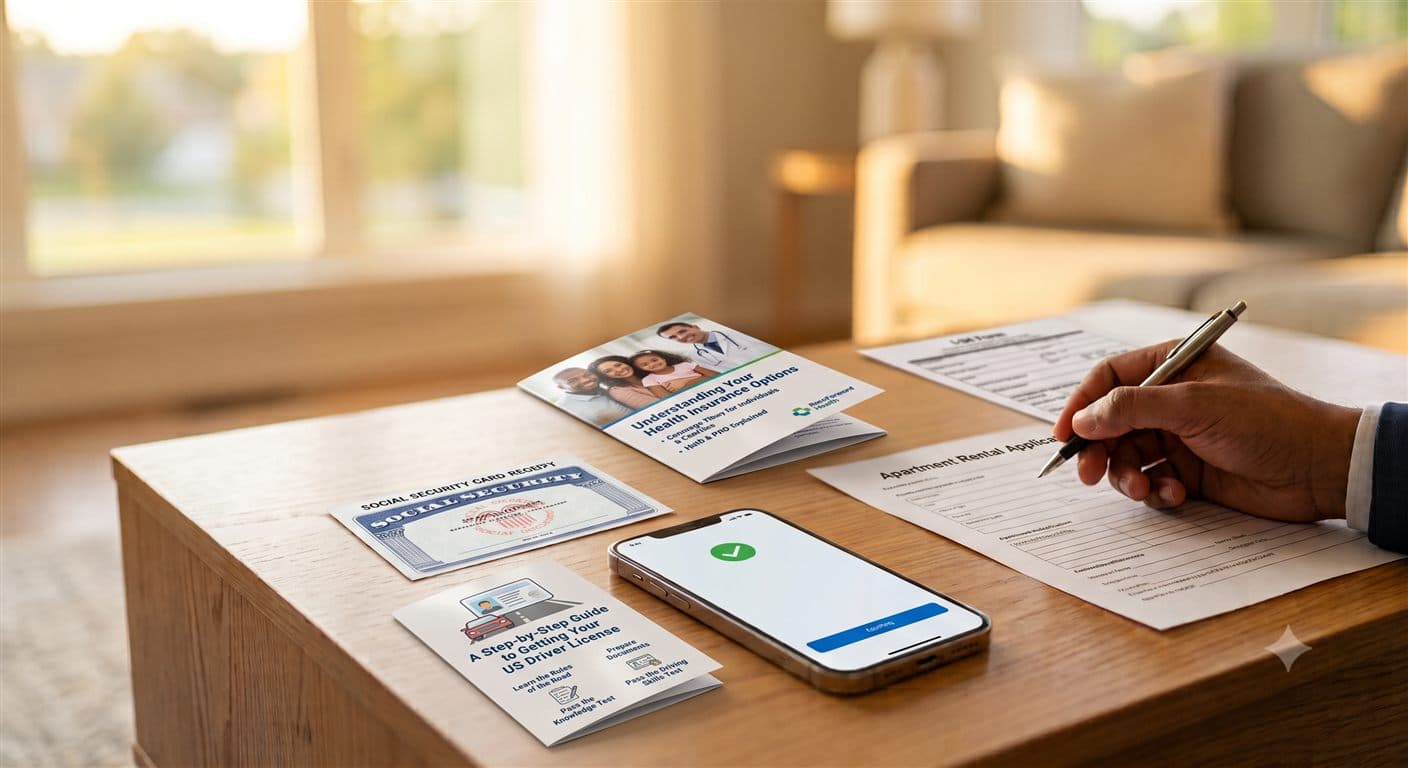
If you are authorized to work, getting a Social Security number is a defined process and it costs nothing. Here is who is eligible, the official ways to apply, what to bring, and how to protect the number afterwards.
Jump to the checklist ↓The Social Security number (SSN) is used across US payroll, credit, banking and government systems. If you are authorized to work, obtaining one is a defined, no-cost process. This guide explains who is eligible, the official ways to apply, what to bring, and how to protect the number afterwards. Every step should be confirmed on the Social Security Administration (SSA) pages linked at the end, because procedures and processing times are updated periodically.
The checklist
12 steps
- 1Confirm you are work-authorized and eligible for an SSN
- 2Know the routes: immigrant visa request, USCIS form request, or in person
- 3Allow time after arrival for records to reach government systems
- 4Gather originals: passport, I-94, and your status or work-authorization document
- 5Complete Form SS-5 and visit your local Social Security office
- 6Never pay anyone — the SSA issues numbers and cards free
- 7Ask HR about starting work while the card is pending
- 8Update your employer and bank once the number arrives
- 9Store the card securely instead of carrying it
- 10Share the number only when there is genuine need
- 11Hang up on calls threatening arrest or demanding payment
- 12Apply for an ITIN instead if you are not work-authorized
This checklist is your map, not the route. The devil is in the details — read the full guide below before acting on any item.
What the SSN is, and who needs one
A Social Security number is a nine-digit number issued by the SSA. It is used to report your wages to the government, to determine eligibility for certain benefits, and widely as an identifier by employers, banks and other institutions. The SSA is clear that a card is not required simply to work in every situation, but employers must be able to report your earnings, so most people who are authorized to work will need one.
There is no fee to be assigned a Social Security number or to receive a card. The SSA does not charge for this service. Any person or website charging a fee to 'get you an SSN' is not providing something the SSA itself does for free.
Where you will use it
In practice, the SSN comes up in several everyday situations. Employers use it to report your wages and withholding to the government, and it appears on the Form W-2 you receive for tax filing. Financial institutions may ask for it when you open certain accounts or apply for credit, because it is used to match your file with the credit reporting system. Government agencies use it for tax administration and, where relevant, benefit eligibility.
Because it is requested so often, it is useful to understand when you are legally required to provide it versus when a business is simply asking. You must provide it to employers and to the IRS. Other businesses may request it, but you can ask why it is needed, how it will be used, and whether an alternative identifier is acceptable. Sharing the number only when there is a genuine need reduces your exposure to identity theft, covered later in this guide.
Who can get one
In general, noncitizens who are authorized to work in the United States by the Department of Homeland Security can be assigned an SSN. This includes categories such as H-1B and L-1 workers, F-1 students with authorized on-campus employment or CPT/OPT, J-1 exchange visitors with the required authorization, and holders of an Employment Authorization Document (EAD), including eligible H-4 spouses who hold an EAD.
People who are not authorized to work generally cannot get an SSN for work purposes. In limited cases, a noncitizen may be assigned an SSN when a federal, state or local law requires it for a non-work purpose; the SSA lists what such applicants must show. If you are not work-authorized and need a number only to file taxes, the IRS Individual Taxpayer Identification Number (ITIN) is the relevant option, covered below.
Three official ways to apply
First, Enumeration at Entry (EAE). If you apply for an immigrant visa (for lawful permanent residence) through the US Department of State using the immigrant visa application, you can request a Social Security number at the same time. People who do this do not need to make a separate visit to a Social Security office; the SSA states the card should arrive by mail after you enter the United States.
Second, Enumeration Beyond Entry (EBE). When you file certain applications with US Citizenship and Immigration Services (USCIS) — for example an application for employment authorization or for adjustment of status — you may be able to request an original or replacement SSN card by completing the SSA questions within that USCIS form, again avoiding a separate SSA visit. Availability depends on the specific form and your situation.
Third, applying in person at a Social Security office. Many people arriving on temporary work or student visas apply this way. You complete Form SS-5, the Application for a Social Security Card, and present original documents. You can find your local office using the SSA office locator.
Before you visit: a document checklist
The SSA generally requires original documents or certified copies issued by the agency that has them — not photocopies or notarized copies. All documents must be current (unexpired). Building your file before the visit avoids a wasted trip.
A general checklist, to confirm against the SSA page for your specific category: proof of identity (your passport is the primary document for most newcomers); proof of immigration status and, where required, work authorization (for example your I-94, and your I-797, I-20 with employment evidence, DS-2019, or EAD as applicable); and a completed Form SS-5. If any document is in a language other than English, ask the SSA in advance whether a certified translation is needed. Where your name appears differently across documents, bring evidence linking them, because the SSA record should match your other records exactly.
Applying in person, step by step
Gather original documents (the SSA generally requires originals or certified copies, not photocopies): your passport with your visa, your Form I-94 arrival record (downloadable from the official CBP site), and evidence of your immigration status and work authorization — for example the I-797 approval notice for H-1B, the Form I-20 with evidence of authorized employment for F-1 students, the DS-2019 for J-1 exchange visitors, or your EAD card. Requirements vary by category, so check the current document list on the SSA page for your situation before you go.
Complete Form SS-5. You can fill it in advance from the SSA site or complete it at the office; a Social Security representative helps process it. There is no charge.
Timing before you apply. The SSA advises that your immigration and admission information needs to be verified in government systems before a number can be assigned, which is why applying very soon after arrival can lead to delays. F-1 students typically need evidence of authorized employment first. Confirm the current guidance, including any recommended waiting period, on the SSA pages for noncitizens and students.
Getting the card, and starting work
The card is mailed to a US address where you can receive mail. The SSA publishes the current expected delivery timelines for cards requested as part of the immigrant visa process and for in-person applications; check the current estimate on the SSA site, as processing times change.
You do not necessarily have to wait for the physical card to begin authorized employment. Employers have an established process for handling a new hire whose SSN is still pending, including completing employment-eligibility paperwork. Ask your employer's HR team how they handle a pending SSN, and confirm details against official guidance rather than assumptions.
Working while your card is on the way
Employment eligibility in the US is documented on Form I-9, which is separate from getting an SSN. USCIS guidance indicates that a new employee who has not yet received a Social Security number can still complete Form I-9 using other acceptable documents, and can begin authorized work; the SSN is entered when it is received. The lists of acceptable I-9 documents are published by USCIS.
If your employer uses E-Verify, the process is a little different: E-Verify requires the Social Security number to create the case, so a worker who does not yet have an SSN may need to wait until it is assigned before the employer can run E-Verify, even though the underlying work authorization already exists. Ask your HR team which process they follow.
Note the difference between an unrestricted card and a restricted one. Cards issued to people who are not authorized to work carry a legend such as 'not valid for employment' or 'valid for work only with DHS authorization'. A restricted card is not, by itself, proof of employment authorization for I-9 purposes. Confirm the current document rules on the USCIS I-9 pages.
Replacing or correcting your card
If your card is lost or stolen, or your information changes, you can request a replacement. Under 20 CFR 422.103(e)(2), replacement cards are limited to three in a year and ten in a lifetime — but the SSA 'may allow for reasonable exceptions to these limits on a case-by-case basis in compelling circumstances', for example where you can show significant hardship. Cards issued to reflect a legal name change, or a change to the work-authorization legend, do not count toward the limits at all, so necessary corrections are not blocked by the cap.
To replace or correct a card, you generally provide documents proving your identity, and, for noncitizens, your immigration status and work authorization, following the current instructions on the SSA 'Replace Social Security card' page. Keep your name consistent across your passport, immigration documents and SSA record; mismatches are a frequent cause of problems later, including at tax time when your employer reports your wages.
When the SSA cannot immediately verify your status
Before assigning a number to a noncitizen, the SSA verifies immigration status with the Department of Homeland Security, in part through the SAVE system. If your records have not yet fully transferred between agencies, or if there is a data or name mismatch, the SSA may be unable to complete your application right away, which is one reason the SSA advises allowing time after arrival before applying.
If you are told your status cannot be verified, this is often a timing or data issue rather than a denial. The SSA can initiate additional verification with DHS. Bring complete, consistent original documents, and if a problem persists, follow up with the Social Security office and, if needed, seek advice from your employer's immigration counsel or your school's international office. Do not pay a third party who promises to 'fix' an SSN issue faster than the official process.
If you are not work-authorized
If you are not authorized to work — for example an H-4 spouse who does not hold an EAD — you generally will not be issued an SSN for work. That does not leave you without options for everyday life. The IRS issues an Individual Taxpayer Identification Number (ITIN) to people who need a US taxpayer identification number but are not eligible for an SSN, so you can meet tax-filing obligations.
For banking, US customer-identification rules allow banks to verify identity using documents such as a passport, so an SSN is not always required to open an account (policies vary by bank). For a state driver's license or ID, states have procedures for applicants who are not eligible for an SSN. Check each institution's or agency's current requirements directly.
Protecting your number
Because the SSN is used so widely as an identifier, treat it carefully. A common recommendation is to avoid carrying the card in your wallet and to store it securely, sharing the number only when there is a legitimate need, such as with an employer, a bank, or a government agency.
Be alert to impersonation scams. The SSA has publicly warned that it will not call to threaten you with arrest or legal action, demand immediate payment, or tell you to move or wire money to 'protect' your number. If you receive such a call, do not provide information; the SSA directs people to report suspected scams to its Office of the Inspector General. If you believe your identity has been misused, the FTC's IdentityTheft.gov provides an official step-by-step recovery process, and placing a free credit freeze with the credit bureaus can help block new accounts being opened in your name.
Official sources
- SSA — Social Security Numbers for Noncitizens (PDF) ↗
- SSA — Social Security Numbers and Immigrant Visas ↗
- SSA — Social Security number and card (apply / locator) ↗
- SSA — Replace Social Security card ↗
- USCIS — Form I-9 Acceptable Documents ↗
- SSA — Scam awareness (Office of the Inspector General) ↗
- IRS — Individual Taxpayer Identification Number (ITIN) ↗
- FTC — IdentityTheft.gov ↗
Keep reading
- Moving to the USA: The Complete 24-Point Relocation ChecklistYour Journey in America
- Opening Your First US Bank Account: Documents, Choices, TrapsYour Journey in America
- Getting a US Driver's License: The Universal PlaybookYour Journey in America
- Children Aging Out of the Green-Card Queue: CSPA for Indian FamiliesImmigration
Disclaimer
This article is general information, not professional advice, and does not create any professional relationship. Rules, fees, dates and eligibility change and can vary by state, agency and individual circumstances. Always cross-verify the details against the official sources listed above before you act, and consult a qualified professional about your specific situation.